Ingredients
Inside the Honey Bae sachet
15 g of honey and four botanical names. Here is what federal health sources say about each one, and where they say nothing.
First, the honey
Honey is the base of every sachet and the only word in the ingredients field. Each sachet holds 15 g, about two teaspoons. The whole box comes to 180 g.
Honey is mostly sugar, and your body handles it that way. The brand does not state calories or sugar per sachet, and it does not name the flowers or the country the honey came from. If you count carbohydrates, count a sachet as 15 g of sugar until the brand says otherwise.
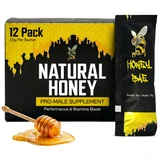
Honey Bae Honey Packs, 12 Sachets12 sachets, 15 g each · $2.91 a sachet
$34.95
Get the 12-Pack on AmazonBotanicals
The four botanicals, one by one
Panax ginseng
Asian ginseng
Panax ginseng is the root most people mean when they say ginseng. It has a long history as a tonic, and an NIH fact sheet records it. The same sheet reads the modern trials, and they are less kind.
Ginseng is also the one botanical here with clear safety notes from a federal health agency. Short-term use looks safe for most people, but it can interact with medicines, and people with diabetes are told to ask first.
“Preparations made from ginseng roots have been used in traditional Chinese medicine for millennia as a tonic to improve stamina and vitality”
“In almost all cases, the studies found that Panax ginseng in various doses and preparations had no ergogenic effect on such measures as peak power output, time to exhaustion, perceived exertion, recovery from intense activity, oxygen consumption, or heart rate”
“Short-term oral use (by mouth, up to 6 months) of Asian ginseng in recommended amounts appears to be safe for most people.”
“Asian ginseng might interact with certain medications.”
Tribulus terrestris
puncture vine
Tribulus terrestris is a low, spiny plant. You will see it on the labels of many supplements sold to men. The NIH fact sheet below describes what marketers say about it and how thin the research is.
For a buyer, the point is simple. A name in a description is not a dose, and a dose is not proof. The Honey Bae description gives the name only.
“Only a few small, short-term clinical trials have investigated Tribulus terrestris as an ergogenic aid”
“Some marketers claim that Tribulus terrestris enhances exercise and athletic performance by increasing serum concentrations of testosterone and luteinizing hormone, but studies have not adequately determined its potential mechanisms of action”
Peruvian maca
Lepidium meyenii
Maca is a root that grows high in the Peruvian Andes, where it is eaten as food. In supplements it is dried and ground to a powder.
The Honey Bae description names Peruvian maca without an amount. Treat it as a named ingredient with an unknown dose, and judge the box by its honey.
Tongkat ali
Eurycoma longifolia
Tongkat ali is the Malay name for Eurycoma longifolia, a shrub from Southeast Asia. Supplement brands use an extract of its root.
As with maca, the description gives the name and nothing else. If you take any regular medicine, show the box to your pharmacist before you try it.
At a glance
Where each ingredient is named
| Ingredient | Ingredients field | Description | Amount stated |
|---|---|---|---|
| Honey | Yes | Yes | 15 g a sachet |
| Panax ginseng | No | Yes | No amount given |
| Tribulus terrestris | No | Yes | No amount given |
| Peruvian maca | No | Yes | No amount given |
| Tongkat ali | No | Yes | No amount given |
What the names do not tell you
A botanical can sit in a product at a pinch or at a full dose, and the name alone looks the same either way. Most supplements settle the question with a Supplement Facts panel. None of the seven Honey Bae product pictures shows one.
That leaves you with a choice. You can buy the box for what it plainly is, honey in a handy sachet, and treat the botanicals as unknown. Or you can write to the brand and ask for the panel before you spend $34.95. We think the second is worth five minutes.
General information, not medical advice. Talk to a doctor or pharmacist before you take a supplement, above all if you take regular medicine.
Questions
About the ingredients
Is Honey Bae just honey?
The ingredients field says only "Honey", and one picture says "100% pure honey". The description names 4 botanicals as well, so the brand's own answers disagree.
How much ginseng is in a Honey Bae sachet?
The amount is not stated. The description names Panax ginseng among 4 botanicals, and no amount in milligrams is printed for any of them.
Sources
Where the quotes come from
- Dietary Supplements for Exercise and Athletic Performanceread 9 October 2026 · NIH Office of Dietary Supplements
- Asian Ginseng: Usefulness and Safetyread 9 October 2026 · National Center for Complementary and Integrative Health